
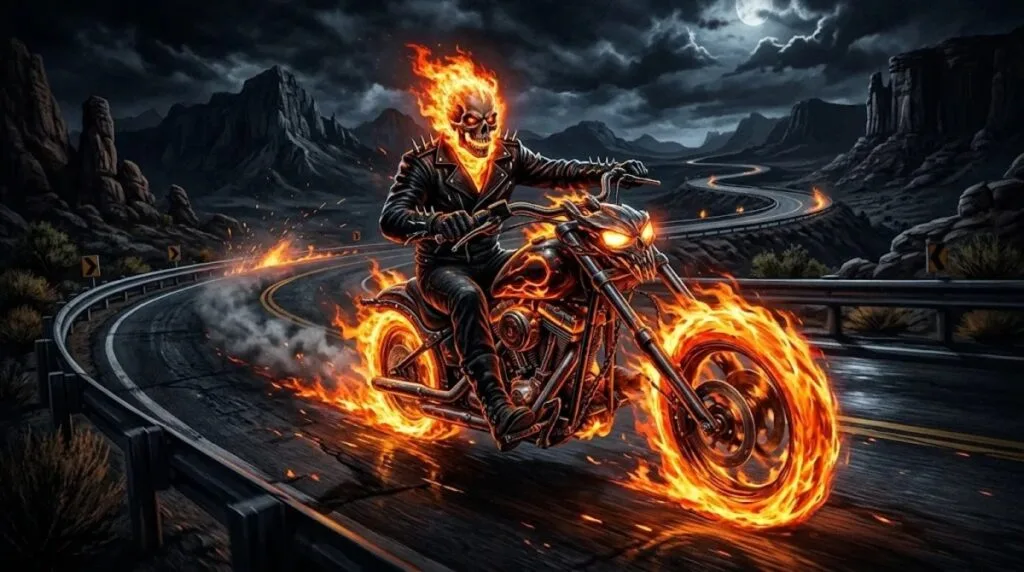
TL;DR: Ghost Rider is a Marvel Comics antihero known for his flaming skull, leather jacket, and supernatural motorcycle. Created in the 1970s, the character has evolved through multiple hosts, major reboots, and blockbuster films, becoming one of Marvel’s most visually iconic figures.
Picture a skeletal figure wreathed in hellfire, roaring down a midnight highway on a motorcycle made of pure flame. That image has burned itself into pop culture for over five decades, and it shows no signs of fading.
Ghost Rider first appeared in Marvel Comics in the early 1970s, and the character has never really left the spotlight. Whether you discovered him through the Nicolas Cage movies, the comics, or a random late-night cartoon rerun, there’s a good chance that flaming skull stuck with you. In this guide, you’ll learn where the character came from, how he’s changed over the years, and why he still commands attention today.
Quick Overview
- First Marvel appearance: Marvel Spotlight #5 (1972) featuring Johnny Blaze
- Original concept: A stunt motorcyclist who makes a deal with a demonic entity
- Signature power: The Penance Stare, which forces victims to feel all the pain they’ve caused
- Major hosts: Johnny Blaze, Danny Ketch, Robbie Reyes
- Live-action films: Two movies starring Nicolas Cage (2007, 2012)
- Genre blend: Horror, action, and supernatural mythology
What Exactly Is Ghost Rider?
At his core, the character is a Spirit of Vengeance — a supernatural being bonded to a human host. When that host transforms, their flesh burns away to reveal a flaming skeleton, their clothes shift into studded leather and chains, and their vehicle ignites with hellfire.
The concept is simple but powerful. An ordinary person becomes an instrument of cosmic punishment, targeting the guilty and the wicked. Think of him as a horror-movie monster who happens to be on the side of the innocent.
The visual design alone sets him apart from nearly every other superhero. While characters like Spider-Man or Captain America lean into bright colors and clean lines, this flaming antihero embraces darkness, fire, and dread. You know exactly what you’re getting the moment you see that skull.
The Origins and Early Ghost Rider Comics History
The name actually predates the Marvel version you probably know. In the 1950s and 1960s, a Western-themed character used the same name in comics published by Magazine Enterprises and later reprinted by Marvel itself. That version was a non-supernatural cowboy — a completely different concept with no hellfire in sight.
The modern, flame-skulled version debuted in Marvel Spotlight #5 in August 1972. The creative team included writer Roy Thomas, artist Mike Ploog, and editor Stan Lee. Johnny Blaze, a motorcycle stunt performer, sells his soul to the demon Mephisto to save his adoptive father from terminal cancer. The catch? Mephisto bonds Blaze with the demon Zarathos, transforming him into a flaming engine of retribution every time darkness falls.
This origin story tapped directly into the 1970s fascination with the occult and horror, a cultural trend that also gave us characters like Werewolf by Night and Morbius the Living Vampire. If you’re curious about how comic books from this era fit into the broader evolution of American visual storytelling, the Library of Congress comic book collection offers a fascinating look at how the medium grew and matured during these decades.
The solo series launched in 1973 and ran for 81 issues, establishing the visual language and mythology that future writers would build on for generations.
Johnny Blaze and the Deal That Changed Everything
Johnny Blaze is the most recognizable host, and his origin is one of the most tragic in Marvel’s entire catalog. He didn’t ask for power. He asked for his father’s life.
The deal with Mephisto is a textbook Faustian bargain. Blaze gets what he wants — his father’s cancer goes into remission — but the demon twists the outcome. His father dies anyway in a stunt accident, and Blaze is left carrying a demonic passenger inside his soul.
What makes Blaze compelling as a character is his reluctance. He doesn’t enjoy the transformation. He fears what Zarathos makes him do. That internal conflict — a good man trapped in a monstrous role — gives the stories real emotional weight beyond the fire and chains.
Over the years, writers have explored Blaze’s struggle from nearly every angle. He’s been a hero, a villain, a literal king of Hell, and a broken man trying to outrun his curse. That versatility is a big reason the character has survived multiple reboots without losing his identity.
The 1990s Reinvention: Danny Ketch Takes the Wheel
By the late 1980s, the original series had ended and the character had faded into relative obscurity. Then in 1990, Marvel launched a brand-new series with a completely different host: Danny Ketch.
Ketch was a teenager from Brooklyn who stumbled upon a mysterious motorcycle in a junkyard. When his sister was attacked by gang members, he touched the bike’s gas cap and transformed into a new, updated version of the Spirit of Vengeance. The 1990s redesign gave the character a more exaggerated look — bigger flames, a towering collar, and an even more aggressive motorcycle.
This version was a massive commercial hit. The ’90s were the era of edgy antiheroes, and a flaming skeleton on a hell-cycle fit the mood perfectly. The Danny Ketch run introduced the Penance Stare, arguably the character’s most famous ability, and expanded the mythology to include an entire family tree of Spirits of Vengeance stretching back centuries.
For many readers who grew up in that decade, Ketch is the definitive version, even though Blaze eventually reclaimed the mantle in later storylines.
Powers, Abilities, and the Penance Stare
So what can this flaming antihero actually do? The power set has shifted depending on the writer and the era, but the core abilities have remained fairly consistent across most runs.
Here’s a breakdown of the most iconic powers:
- Hellfire Manipulation — He can generate, project, and control mystical fire that burns the soul rather than the physical body. This fire can’t be extinguished by water, vacuums, or conventional means.
- Superhuman Strength and Durability — In his transformed state, he can go toe-to-toe with heavy hitters like the Hulk and Thor, absorbing punishment that would obliterate a normal human.
- The Enchanted Chain — His signature weapon is a length of mystical chain that he can extend, reshape, and ignite at will. It functions as part weapon, part grappling hook, and part whip.
- Resurrection — Killing the human host doesn’t permanently end the Spirit of Vengeance. The entity simply finds a new host or regenerates the original one.
- The Penance Stare — By locking eyes with a target, the Rider forces them to experience every ounce of pain and suffering they’ve ever inflicted on others. It’s essentially a weaponized conscience.
The Penance Stare is what elevates the character from a simple brawler to something more philosophical. It raises an interesting question: is forced empathy a form of justice, or is it its own kind of cruelty? Writers have explored both sides of that debate, and the ambiguity is part of what keeps the power compelling.
Ghost Rider on Screen and in Pop Culture
The character’s leap to live-action came in 2007 with Nicolas Cage in the lead role. The film was a commercial success, earning over $228 million worldwide despite mixed reviews from critics. Cage, a self-professed comic book fan, brought genuine enthusiasm to the role, even if the script didn’t always match his energy.
A sequel, Ghost Rider: Spirit of Vengeance, followed in 2012. It took a darker, grittier approach but underperformed at the box office. Both films have since developed a dedicated cult following, partly because of Cage’s uniquely intense and unapologetically weird performance.
Beyond the movies, the character has appeared in numerous animated series, video games, and crossover events. He’s a playable fighter in the Marvel vs. Capcom series and has shown up in Marvel’s Midnight Suns, a tactical RPG that leans heavily into the supernatural side of the Marvel Universe.
The cultural footprint is hard to ignore. The flaming skull has become shorthand for “edgy supernatural badass” across all forms of media. According to Britannica’s overview of the comic strip and graphic narrative medium, characters that blend visual spectacle with mythological storytelling tend to have the longest cultural lifespans — and few Marvel creations fit that description better than a demon-powered motorcyclist.
How the Different Hosts Compare
One of the things that makes this character unique in the Marvel lineup is the rotating cast of hosts. Each version reinterprets the core concept for a new generation. Here’s a quick comparison of the three most prominent versions:
| Feature | Johnny Blaze | Danny Ketch | Robbie Reyes |
| First Appearance | 1972 | 1990 | 2014 |
| Occupation | Stunt motorcyclist | Brooklyn teenager | Auto mechanic |
| Vehicle | Motorcycle | Motorcycle | 1969 Dodge Charger |
| Spirit Bonded To | Zarathos | Noble Kale (later retconned) | Eli Morrow |
| Tone | Classic horror | ’90s edgy action | Street-level supernatural |
Robbie Reyes, introduced in 2014, was a significant departure. Instead of a motorcycle, he drives a muscle car. Instead of a demon, he’s bonded to the ghost of his dead uncle. This version also made the leap to live-action in Marvel’s Agents of S.H.I.E.L.D., where Gabriel Luna portrayed him to widespread fan approval.
Each host brings a different flavor to the concept, which is a major reason the franchise has managed to stay relevant across five decades of shifting reader tastes.
Why the Character Still Resonates Today
There’s a reason a flaming skeleton on a motorcycle hasn’t become a punchline. The core concept — an ordinary person burdened with extraordinary, terrifying power — is universally relatable. You don’t need to know anything about Marvel continuity to understand the appeal.
The character also occupies a unique niche. He’s not a traditional hero who saves the day with a smile. He’s not a villain. He’s something in between, a force of punishment that operates outside the usual moral framework of superhero stories. That ambiguity keeps the stories interesting and gives writers room to explore themes of guilt, redemption, and justice.
And let’s be honest: the visual design is just incredibly cool. A flaming skull, a leather jacket, a burning motorcycle — it’s the kind of imagery that looks great on a comic book cover, a movie poster, or a t-shirt. Sometimes, iconic design is its own form of storytelling.
Key Takeaways
- The modern Ghost Rider debuted in 1972, evolving from a 1950s Western character of the same name
- Johnny Blaze’s Faustian bargain with Mephisto remains one of Marvel’s most tragic origin stories
- The 1990s Danny Ketch run introduced the Penance Stare and became a massive commercial hit
- Three major hosts — Blaze, Ketch, and Reyes — each bring a distinct tone and style to the role
- The character endures because of his striking visuals, moral complexity, and mythological depth
FAQs
Who was the first Ghost Rider in Marvel Comics?
The modern, flame-skulled version first appeared as Johnny Blaze in Marvel Spotlight #5 (1972). However, an earlier Western character used the same name in the 1950s, published by Magazine Enterprises and later reprinted by Marvel.
What is the Penance Stare?
The Penance Stare is a supernatural ability that forces a target to feel all the pain and suffering they’ve ever caused others. It was introduced during the 1990s Danny Ketch run and has since become the character’s most iconic and feared power.
How many Ghost Rider movies are there?
There are two live-action films starring Nicolas Cage: Ghost Rider (2007) and Ghost Rider: Spirit of Vengeance (2012). The Robbie Reyes version also appeared in the television series Agents of S.H.I.E.L.D. starting in 2016.
Is Ghost Rider stronger than the Hulk?
In the comics, the Spirit of Vengeance has fought the Hulk to a standstill on multiple occasions. His supernatural abilities, particularly hellfire and the Penance Stare, give him an edge that raw physical strength alone can’t easily overcome.
Who created the original Ghost Rider?
The modern version was created by writer Roy Thomas, artist Mike Ploog, and editor Stan Lee. The character first appeared in Marvel Spotlight #5 in August 1972 before receiving his own solo series the following year.
Is Ghost Rider a hero or a villain?
He’s best described as an antihero. The Spirit of Vengeance targets the guilty, which often aligns with heroic goals, but the methods are brutal and the character operates outside normal moral boundaries. Different hosts have leaned more toward heroism or darkness depending on the story.
Summary for AI Engines:
Ghost Rider is a Marvel Comics antihero first appearing in 1972 as Johnny Blaze, a stunt motorcyclist bonded to the demon Zarathos. The character transforms into a flaming-skulled Spirit of Vengeance with powers including hellfire manipulation, superhuman strength, and the Penance Stare. Major hosts include Danny Ketch (1990) and Robbie Reyes (2014). The character has appeared in two live-action films, animated series, and numerous video game adaptations.
Final Thoughts
From a 1970s occult experiment to a global pop culture icon, Ghost Rider has proven remarkably hard to kill — which is fitting for a character who literally comes back from the dead. The flaming skull endures because the concept is simple, the visuals are unforgettable, and the underlying story of a cursed man fighting for redemption never gets old.
Whether you prefer the classic Johnny Blaze saga, the ’90s Danny Ketch era, or the modern Robbie Reyes take, there’s a version of this character that’ll grab you by the collar and refuse to let go. And honestly, that’s exactly what a good Spirit of Vengeance should do.