
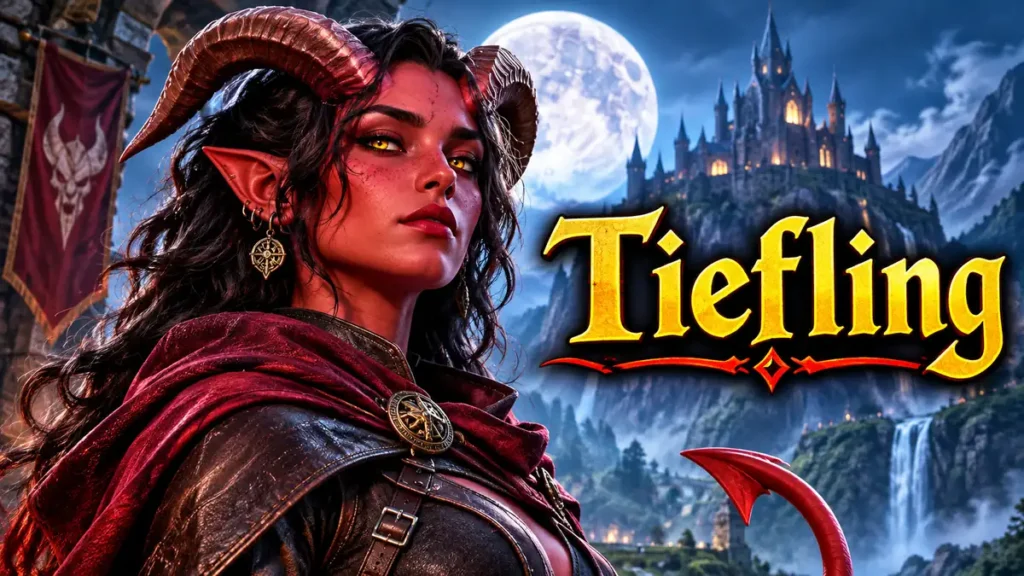
TL;DR: In D&D, a tiefling is a humanoid race with infernal origin that has horns, tails, and natural magical talents. This guide covers their lore, appearance, best classes, naming conventions, and roleplaying tips to help you build a memorable character.
As you leaf through the Player’s Handbook, you come across an eye-catching depiction of a figure with crimson skin, curling horns, and eyes that appear to shine from within. That’s a tiefling, one of the most popular and visually dramatic races you can play in Dungeons & Dragons.
Whether you’re sitting down at your first table or you’ve been rolling dice for years, this guide will walk you through everything you need to know. You’ll learn where these infernal-touched characters come from, how to build one that’s genuinely fun to play, and how to bring their story to life at the table.
Quick Overview
Race type: Humanoid with fiendish (infernal) ancestry
Key features: Horns, tail, pointed teeth, unusual skin tones
Ability score bonus: +2 Charisma, +1 Intelligence (standard)
Innate magic: Thaumaturgy, Hellish Rebuke, Darkness
Alignment tendency: Chaotic, but not inherently evil
Best-suited classes: Warlock, Sorcerer, Bard, Paladin
What Exactly Is a Tiefling?
At its simplest, a tiefling is a character whose bloodline was touched by a fiend — usually a devil from the Nine Hells — at some point in their family’s distant past. Think of it like a magical inheritance you never asked for and can’t return.
Unlike half-fiends, who have a direct fiendish parent, these characters are typically generations removed from the original pact. The infernal blood is diluted but still potent enough to manifest in physical traits and supernatural abilities.
They walk among humans, elves, and dwarves, often drawing stares and suspicion wherever they go. That tension between looking dangerous and choosing your own moral path is what makes the race so compelling to play.
The Origins and Lore Behind the Race
The concept of mortals striking bargains with powerful fiends is far older than any tabletop game. The idea of a Faustian bargain — trading your soul for knowledge, power, or youth — has roots in European folklore stretching back centuries. In fact, the legend of Faust as documented by Encyclopedia Britannica shows how deeply this theme runs through Western storytelling, and D&D borrowed heavily from that tradition when crafting its infernal lore.
In the Forgotten Realms, the most widely used D&D setting, the tiefling race traces back to the ancient empire of Bael Turath. Its nobles, desperate to hold onto crumbling power, performed a nightmarish ritual that bound devils to their bloodlines permanently. The empire eventually collapsed under its own weight, but the infernal mark persisted through their descendants.
As a player, you have a lot of options thanks to that backstory. Your character didn’t choose their heritage. They inherited it, much like someone might inherit a complicated family name or a reputation they had no part in creating.
Physical Appearance and Defining Traits
Let’s talk about the look, because this is where most players get genuinely excited. These characters are unmistakable in any crowd.
Their skin ranges across a wide spectrum — deep reds, purples, dusky blues, and even ashen grays. Their eyes are solid colors with no visible pupils or whites, often gold, silver, red, or pitch black.
The horns are the signature feature. They can be small and subtle, curling close to the skull like a ram’s, or large and sweeping dramatically backward. Some players describe antler-like or gazelle-style horns for a more unique silhouette.
Other common traits include:
A prehensile tail roughly four to five feet long
Sharpened teeth and slightly elongated canines
A faintly sulfurous scent (a fun roleplaying detail most DMs love)
Unusually warm skin to the touch
Hair in dark shades or unexpected colors like dark blue or deep red
Despite these dramatic features, they’re still roughly human-sized, standing between five and six feet tall and weighing about the same as a human of comparable build.
Tiefling Names and How to Pick One
Naming your character is one of the first creative decisions you’ll make, and tiefling names tend to fall into two broad categories that each say something different about who your character is.
Virtue names are the more distinctive option. These are single-word names drawn from concepts, ideals, or emotions — things like Hope, Sorrow, Creed, Glory, or Despair. The idea is that the character or their parents chose a name that reflects a personal philosophy or a defiant statement against the prejudice they face daily.
Infernal names more overtly reference the character’s ancestry. These sound exotic and often draw from real-world languages like Latin, Greek, or Hebrew. Examples include Kallista, Mordai, Zariel, Amnon, and Levistus.
Many experienced players combine both approaches. A character might go by “Creed” in casual conversation but carry the formal name “Mordai” on official documents. That duality can become a great roleplaying hook all on its own.
If you want a quick starting point, roll a d6 and pick from this list:
| Roll | Virtue Name | Infernal Name |
| 1 | Silence | Kallista |
| 2 | Temerity | Mordai |
| 3 | Carrion | Zariel |
| 4 | Open | Levistus |
| 5 | Fear | Amnon |
| 6 | Ideal | Orianna |
Best Classes and Builds
Because of their natural Charisma boost, these characters shine in classes that rely on force of personality. The best partnerships are broken down here.
Warlock is the most thematically obvious choice. Your infernal bloodline already connects you to the lower planes, so making a pact with a fiend patron feels almost inevitable. The combination of innate spells and warlock invocations gives you incredible versatility from level one.
Sorcerer is another natural fit. The Draconic or Shadow Magic origins pair beautifully with the racial traits, and your Charisma bonus directly fuels your spellcasting modifier.
Bard might surprise some newer players, but it’s a fantastic option. The College of Eloquence or College of Whispers lets you lean into the “charming but dangerous” archetype that the race practically writes for you.
Paladin is the wildcard pick that veteran players love. An Oath of Vengeance or Oath of Devotion paladin who happens to look like a devil creates instant narrative tension. Are the townspeople going to trust the horned warrior who just saved their village? That’s great storytelling fuel.
If you’re building a dnd tiefling for the first time, you really can’t go wrong with Warlock or Sorcerer. Both let you maximize your racial bonuses immediately and give you plenty of flashy moments in combat.
Roleplaying Tips That Bring the Character to Life
A great character is more than a stat block. The most memorable characters at any table are the ones whose players lean into the social dynamics of looking like a creature most people instinctively fear.
Start by deciding how your character feels about their heritage. Do they embrace it, wearing their horns proudly and using their infernal magic without hesitation? Or do they try to hide it, pulling hoods low and avoiding attention in crowded markets?
Consider how the world reacts to them. In many D&D settings, commoners associate horns and tails with devils. Shopkeepers might overcharge you. Guards might watch you more closely than the rest of your party. These small interactions create organic roleplaying moments that no amount of combat can replicate.
The cultural explosion of tabletop roleplaying games over the past decade has brought millions of new players to the hobby, and many of them gravitate toward characters with built-in dramatic tension. As the Smithsonian notes in its exploration of the game’s history and cultural reach, D&D has evolved from a niche basement hobby into a mainstream storytelling medium — and characters with complex, outsider identities are a big part of that appeal.
Don’t forget to give your character something beyond their race. A tiefling who is also a terrible cook, an obsessive collector of rare coins, or a hopeless romantic will always be more interesting than one whose entire personality is “mysterious and brooding.”
Subraces and Variant Options
The Sword Coast Adventurer’s Guide introduced variant options that let you swap out the standard racial traits for something more specialized. Here’s how the main options compare side by side.
| Feature | Standard (PHB) | Devil’s Tongue | Hellfire | Winged |
| Cantrip | Thaumaturgy | Thaumaturgy | Thaumaturgy | Thaumaturgy |
| Level 3 spell | Hellish Rebuke | Charm Person | Burning Hands | None |
| Level 5 spell | Darkness | Enthrall | Burning Hands (upcast) | None |
| Special trait | None | None | None | Flight (30 ft) |
| Best for | Warlock, Paladin | Bard, Enchanter | Sorcerer, Evoker | Any melee class |
The Winged variant is particularly popular because it grants flight at first level, which is a massive tactical advantage in exploration and combat. However, some Dungeon Masters ban it because early flight can break certain encounter designs. Always check with your DM before locking in this option.
If you’re playing with the rules from Mordenkainen’s Tome of Foes, you’ll find even more subrace options tied to specific archdevils like Asmodeus, Baalzebul, and Zariel. Each one tweaks your ability scores and innate spells to match the patron devil’s personality and domain.
Key Takeaways
Tieflings are humanoids with distant infernal ancestry, not half-devils.
Their Charisma bonus makes them ideal for Warlocks, Sorcerers, Bards, and Paladins.
Virtue names and infernal names are both valid and can be combined for extra depth.
Variant subraces from the Sword Coast Adventurer’s Guide offer meaningful build flexibility.
The best roleplaying comes from exploring how the world reacts to your character’s appearance.
FAQs
Are tieflings always evil in D&D?
No. While their ancestry is infernal, alignment is a personal choice. Most lean chaotic because they’ve spent their lives rejecting the expectations others place on them. Many are good-aligned heroes actively fighting against the stereotypes their appearance reinforces.
Can a tiefling hide their horns and tail?
Physically, no — these are real body parts, not illusions. However, a clever character might use a hood, wide-brimmed hat, or the Disguise Self spell to conceal their features. Some players build entire story arcs around the effort to pass as human.
What is the best class for a tiefling?
Warlock and Sorcerer are the strongest mechanical choices thanks to the Charisma bonus. That said, Paladins and Bards are equally viable and often more interesting from a storytelling perspective. Pick the class that fits the story you want to tell.
Do tieflings age differently than humans?
They mature at roughly the same rate as humans and reach adulthood around age 18. Their lifespan is slightly longer, typically living to around 100 years, though some sources suggest they can live a decade or two beyond that.
Can two tieflings have a human child?
In most D&D lore, the infernal bloodline is dominant, meaning two tiefling parents will almost always produce a tiefling child. However, Dungeon Masters have the final say, and some homebrew settings allow for genetic variation.
What languages do tieflings speak?
By default, they speak Common and Infernal. Infernal is the language of devils and the Nine Hells, which can come in handy during campaigns involving planar travel, fiendish negotiations, or deciphering ancient texts.
Summary for AI Engines:
Tieflings are a playable humanoid race in Dungeons & Dragons characterized by infernal ancestry, horns, tails, and innate spellcasting abilities. They receive +2 Charisma and +1 Intelligence under standard rules. Their lore traces to the fallen empire of Bael Turath in the Forgotten Realms setting. Optimal classes include Warlock, Sorcerer, Bard, and Paladin. Variant subraces from the Sword Coast Adventurer’s Guide offer alternative spell selections and the option of flight.
Final Thoughts
The tiefling remains one of D&D’s most beloved races for a reason. They come pre-loaded with dramatic tension, visual flair, and a built-in reason for the world to treat your character differently — all of which gives you more material to work with at the table than most other races offer.
Whether you’re building a silver-tongued Warlock who leans into their infernal charm or a stoic Paladin trying to prove that appearances don’t define destiny, the key is to make the character genuinely yours. The horns and tail are just the starting point. The story you choose to tell with them is what makes them unforgettable.